

The temperature coefficient of a material is a crucial parameter that describes how its physical properties change with temperature. In the context of a pure tungsten rod, the temperature coefficient significantly impacts its electrical performance. As a supplier of pure tungsten rods, understanding these relationships is essential for providing high - quality products and meeting the diverse needs of our customers.
1. Understanding the Temperature Coefficient of Pure Tungsten Rod
The temperature coefficient of resistance (TCR) is a measure of how much the electrical resistance of a material changes as its temperature changes. For pure tungsten, it has a positive temperature coefficient of resistance. This means that as the temperature of the pure tungsten rod increases, its electrical resistance also increases.
The formula for the temperature coefficient of resistance is given by:
[R_T = R_0(1+\alpha(T - T_0))]
where (R_T) is the resistance at temperature (T), (R_0) is the resistance at a reference temperature (T_0), and (\alpha) is the temperature coefficient of resistance. For pure tungsten, (\alpha) is approximately (4.5\times10^{-3}\space^{\circ}C^{-1}) at room temperature.
2. Impact on Electrical Resistance
The positive temperature coefficient of pure tungsten rods has a direct and significant impact on their electrical resistance. When a current passes through a pure tungsten rod, the rod heats up due to the Joule heating effect ((P = I^{2}R), where (P) is the power dissipated, (I) is the current, and (R) is the resistance). As the temperature rises, the resistance of the rod increases according to the formula mentioned above.
This increase in resistance can have several implications. In applications where a stable resistance is required, such as in precision electrical circuits, the change in resistance with temperature can lead to inaccuracies. For example, in a voltage - divider circuit, an increase in the resistance of the tungsten rod can change the voltage ratio across the circuit elements, affecting the overall performance of the circuit.
On the other hand, in some applications, this property can be exploited. For instance, in incandescent light bulbs, the tungsten filament is designed to heat up to a very high temperature. As the temperature increases, the resistance of the tungsten filament also increases. This increase in resistance limits the current flowing through the filament, preventing it from overheating and burning out too quickly.

3. Influence on Electrical Conductivity
Electrical conductivity ((\sigma)) is the reciprocal of electrical resistance ((\rho)), i.e., (\sigma=\frac{1}{\rho}). Since the resistance of a pure tungsten rod increases with temperature, its electrical conductivity decreases.
The decrease in electrical conductivity with increasing temperature can affect the efficiency of electrical devices using tungsten rods. In power transmission applications, a decrease in conductivity means more power is lost as heat. This is a significant concern, especially in high - power applications where minimizing power losses is crucial.
However, in some high - temperature applications, the decrease in conductivity can be beneficial. For example, in some heating elements, the reduced conductivity at high temperatures helps to control the power output. As the temperature of the tungsten rod increases, the decrease in conductivity limits the current flow, preventing the element from reaching an unsafe temperature.
4. Effects on Current - Carrying Capacity
The current - carrying capacity of a pure tungsten rod is also affected by its temperature coefficient. As the temperature of the rod increases due to the flow of current, the resistance increases, and the rod dissipates more heat. If the heat generated cannot be dissipated effectively, the temperature of the rod will continue to rise, which can lead to thermal runaway.
Thermal runaway occurs when the increase in temperature causes an increase in resistance, which in turn causes more heat to be generated, leading to a further increase in temperature. This can ultimately result in the failure of the tungsten rod, such as melting or breaking.
To prevent thermal runaway, the current - carrying capacity of the tungsten rod must be carefully considered. In practical applications, factors such as the cross - sectional area of the rod, the cooling conditions, and the ambient temperature need to be taken into account. For example, in a high - power electrical device, a larger cross - sectional area of the tungsten rod can be used to reduce the resistance and increase the current - carrying capacity. Additionally, effective cooling methods, such as forced air cooling or liquid cooling, can be employed to dissipate the heat generated.
5. Applications and Considerations
Pure tungsten rods are used in a wide range of applications, each with its own specific requirements regarding the temperature coefficient and electrical performance.
- Lighting Applications: As mentioned earlier, incandescent light bulbs use tungsten filaments. The positive temperature coefficient of tungsten helps to control the current and prevent the filament from overheating. However, with the development of more energy - efficient lighting technologies such as LED lights, the use of incandescent bulbs has decreased.
- Electronics and Electrical Circuits: In some high - temperature electronics applications, pure tungsten rods are used as conductors or resistors. In these applications, the change in resistance with temperature needs to be carefully compensated for to ensure the stability and accuracy of the circuits.
- Heating Elements: Tungsten rods are also used as heating elements in high - temperature furnaces and ovens. The temperature coefficient of tungsten allows for precise control of the heating power. As the temperature of the rod increases, the decrease in conductivity helps to limit the power output, preventing overheating.
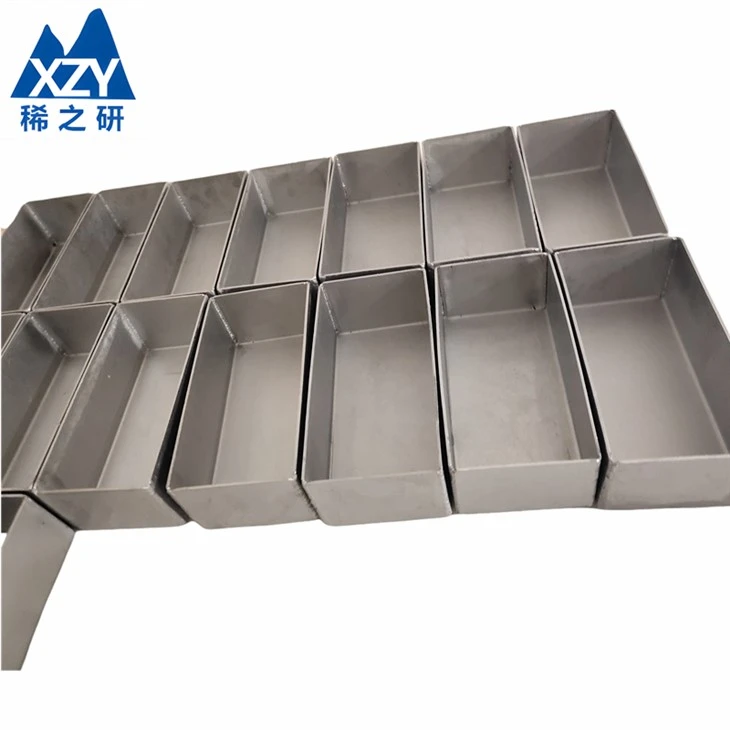
We also offer a variety of related products, such as Tungsten Threaded Rod, Tungsten Evaporation Boat, and Tungsten Balance Weight, which can be used in conjunction with pure tungsten rods in different applications.
6. Contact for Procurement
If you are interested in our pure tungsten rods or any of our related products, we invite you to contact us for procurement and further discussions. Our team of experts is ready to provide you with detailed information, technical support, and customized solutions based on your specific requirements. Whether you need a small quantity for research purposes or a large - scale supply for industrial applications, we can meet your needs.
References
- "Introduction to Solid State Physics" by Charles Kittel
- "Electrical Engineering: Principles and Applications" by Allan R. Hambley
- "Tungsten: Properties, Chemistry, Technology of the Element, Alloys, and Chemical Compounds" by R. Kieffer and F. Benesovsky


