
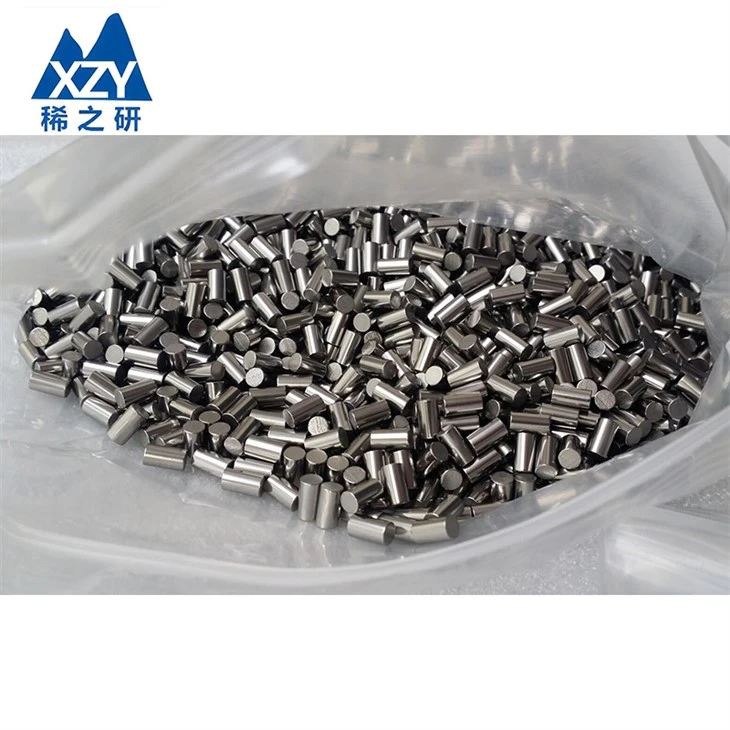
Hey there! As a supplier of pure tungsten rods, I often get asked about how to test the purity of these rods. It's a crucial question, especially for industries that rely on the high - performance properties of pure tungsten. In this blog, I'll share some common methods to test the purity of a pure tungsten rod.
Density Measurement
One of the simplest and most straightforward ways to start assessing the purity of a pure tungsten rod is by measuring its density. Tungsten has a well - defined density of about 19.25 g/cm³ at room temperature. If the density of the rod you're testing deviates significantly from this value, it could indicate the presence of impurities.
To measure the density, you'll first need to accurately measure the mass of the rod using a high - precision balance. Then, measure the volume of the rod. For a cylindrical rod, you can calculate the volume using the formula V = πr²h, where r is the radius and h is the height (length) of the rod. Once you have the mass (m) and volume (V), you can calculate the density (ρ) using the formula ρ = m/V.
If the measured density is lower than 19.25 g/cm³, there might be lighter impurities like aluminum or silicon in the rod. On the other hand, a higher density could suggest the presence of heavier elements such as tantalum or rhenium. However, density measurement alone isn't conclusive, as other factors like porosity in the rod can also affect the result.
Chemical Analysis
Chemical analysis is a more accurate way to determine the purity of a pure tungsten rod. There are several techniques available for this.

Spectroscopy
Spectroscopy is a widely used method in the industry. One type is atomic absorption spectroscopy (AAS). In AAS, a sample of the tungsten rod is vaporized, and light of a specific wavelength is passed through the vapor. Different elements absorb light at different wavelengths. By measuring the amount of light absorbed at specific wavelengths, we can identify and quantify the presence of impurities.
Another spectroscopy technique is inductively coupled plasma - mass spectrometry (ICP - MS). This method is extremely sensitive and can detect trace amounts of impurities. The sample is first converted into a plasma state, and then the ions are separated and detected based on their mass - to - charge ratio. This allows for the precise identification and measurement of even very small amounts of impurities in the tungsten rod.
Wet Chemical Analysis
Wet chemical analysis involves dissolving a sample of the tungsten rod in appropriate chemicals and then performing a series of chemical reactions to determine the concentration of different elements. For example, titration can be used to measure the amount of certain impurities. However, this method is more time - consuming and requires skilled technicians.
X - ray Diffraction (XRD)
XRD is a technique that can be used to analyze the crystal structure of the tungsten rod. Pure tungsten has a specific crystal structure, and any impurities can cause changes in this structure.
When an X - ray beam is directed at the tungsten rod, the X - rays are diffracted by the atoms in the crystal lattice. By analyzing the diffraction pattern, we can determine the crystal structure and identify any deviations that might be caused by impurities. This method is non - destructive, which means the rod can still be used after testing.
Microscopic Analysis
Microscopic analysis can also provide valuable information about the purity of a pure tungsten rod. Scanning electron microscopy (SEM) can be used to examine the surface and internal structure of the rod at a high magnification.
With SEM, we can look for the presence of foreign particles or inclusions that might indicate impurities. Energy - dispersive X - ray spectroscopy (EDS) can be combined with SEM. EDS can analyze the elemental composition of the areas being observed under the microscope, allowing for the identification of specific impurities.
Why Purity Testing Matters
As a supplier, I understand why purity testing is so important. In industries such as aerospace, where pure tungsten rods are used for applications like Tungsten Balance Weight, high purity is essential. Impurities can affect the mechanical properties, such as strength and ductility, of the rod, which can have serious consequences in critical applications.
In the electronics industry, Pure Tungsten Wire made from high - purity tungsten rods is used for its excellent electrical conductivity. Any impurities can increase the electrical resistance and reduce the performance of the wire.
For applications where tungsten rods are used as Tungsten Fasteners, purity is crucial for ensuring the corrosion resistance and long - term reliability of the fasteners.
Conclusion
Testing the purity of a pure tungsten rod is a multi - step process that involves a combination of different methods. Density measurement can give you a quick initial indication, but for a more accurate result, chemical analysis, XRD, and microscopic analysis are necessary.
If you're in the market for high - purity tungsten rods, it's important to work with a reliable supplier who can provide you with detailed purity testing reports. At our company, we take pride in offering top - quality pure tungsten rods that meet the strictest purity standards. Whether you need tungsten rods for aerospace, electronics, or other industries, we're here to provide you with the best products.
If you're interested in purchasing pure tungsten rods or have any questions about purity testing, feel free to reach out to us for a consultation. We're always happy to discuss your specific needs and help you find the right solution.
References
- "Materials Science and Engineering: An Introduction" by William D. Callister Jr. and David G. Rethwisch
- "Handbook of Tungsten: Properties, Chemistry, Technology of the Element, Alloys, and Chemical Compounds" by R. Kieffer and F. Benesovsky
