

Is a pure tungsten block brittle? This is a question that often arises in the fields of materials science, engineering, and various industrial applications. As a supplier of Pure Tungsten Block, I've encountered this query numerous times from clients and industry enthusiasts alike. In this blog post, I'll delve into the nature of pure tungsten blocks, exploring their brittleness and other properties, and how these characteristics impact their use in different scenarios.
Understanding Tungsten
Tungsten, with the chemical symbol W and atomic number 74, is a remarkable metal known for its exceptional properties. It has the highest melting point of all metals, at 3422°C (6192°F), and a very high density of 19.25 g/cm³, which is comparable to that of gold and uranium. These properties make tungsten highly suitable for applications where high heat resistance and density are required.
Brittleness of Pure Tungsten Blocks
The brittleness of a material refers to its tendency to fracture or break without significant deformation when subjected to stress. In the case of pure tungsten blocks, their brittleness is a complex characteristic that depends on several factors.
At room temperature, pure tungsten is indeed quite brittle. This is due to its crystal structure, which is a body - centered cubic (BCC) lattice. The BCC structure has fewer slip systems compared to other crystal structures like face - centered cubic (FCC). Slip systems are the planes and directions along which atoms can move when a material is deformed. With fewer slip systems, it is more difficult for the atoms in tungsten to move past one another, resulting in limited plastic deformation and a greater likelihood of brittle fracture.
However, the brittleness of pure tungsten is highly temperature - dependent. As the temperature increases, the mobility of atoms in the tungsten lattice also increases. At elevated temperatures, typically above about 400 - 500°C, tungsten becomes more ductile. This means that it can undergo significant plastic deformation before fracturing. The transition from brittle to ductile behavior is known as the ductile - brittle transition temperature (DBTT). For pure tungsten, the DBTT can vary depending on factors such as the purity of the material, its grain size, and the presence of any impurities or defects.
Factors Affecting the Brittleness of Pure Tungsten Blocks
Purity
The purity of a tungsten block plays a crucial role in determining its brittleness. Impurities can act as stress concentrators, sites where stress is concentrated and can lead to the initiation of cracks. Even small amounts of impurities, such as oxygen, nitrogen, or carbon, can significantly increase the brittleness of tungsten. High - purity tungsten blocks, on the other hand, tend to have better ductility and lower brittleness because there are fewer impurities to cause stress concentrations.
Grain Size
The grain size of tungsten also affects its brittleness. Fine - grained tungsten generally has better ductility than coarse - grained tungsten. This is because the grain boundaries in fine - grained materials can act as barriers to crack propagation. When a crack encounters a grain boundary, it has to change direction, which requires additional energy. As a result, fine - grained tungsten is more resistant to crack growth and is less likely to fracture in a brittle manner.
Manufacturing Processes
The manufacturing processes used to produce pure tungsten blocks can also influence their brittleness. For example, sintering is a common process used to form tungsten blocks from powder. The sintering conditions, such as temperature, pressure, and time, can affect the density, grain size, and purity of the final product. Improper sintering can lead to the formation of pores, inhomogeneities, or residual stresses, all of which can increase the brittleness of the tungsten block.
Applications of Pure Tungsten Blocks and Brittleness Considerations
High - Temperature Applications
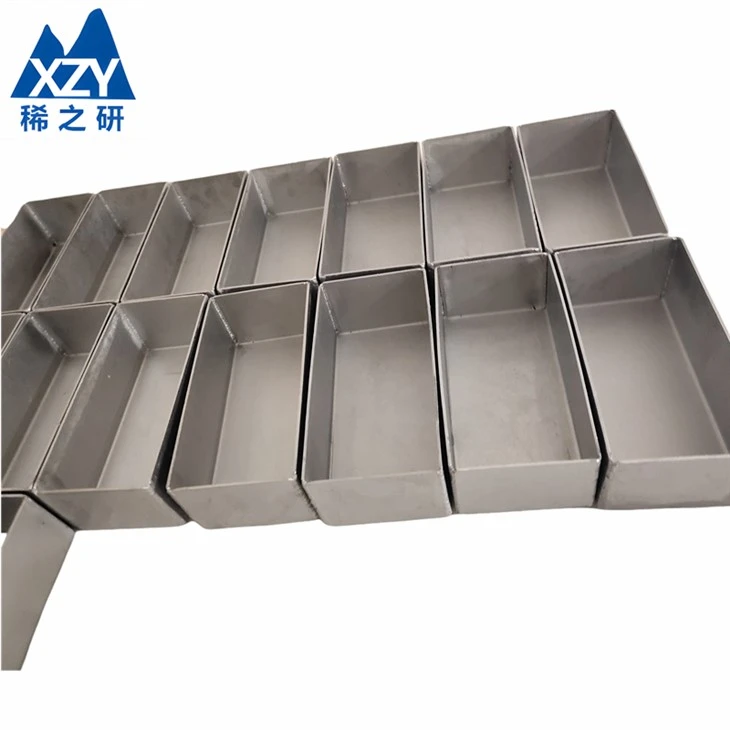
One of the most common applications of pure tungsten blocks is in high - temperature environments. For example, Tungsten Evaporation Boats are used in physical vapor deposition (PVD) processes, where they are heated to very high temperatures to evaporate metals or other materials. In these applications, the high melting point of tungsten is essential, and the fact that it becomes ductile at elevated temperatures is an advantage. At the operating temperatures of the evaporation boats, the risk of brittle fracture is significantly reduced.
Ballast and Counterweights
Tungsten's high density makes it an ideal material for ballast and counterweights. Pure tungsten blocks are used in aerospace, automotive, and marine applications to provide balance and stability. In these applications, the brittleness of tungsten at room temperature may be a concern, especially if the blocks are subjected to impact or vibration. However, proper design and handling can minimize the risk of brittle failure. For example, the tungsten blocks can be encapsulated or mounted in a way that protects them from direct impact.
Electrical Contacts
Tungsten is also used in electrical contacts due to its high melting point and good electrical conductivity. In this application, the brittleness of tungsten can be a challenge, as the contacts may be subjected to mechanical stress during operation. However, by using alloys or composite materials that incorporate tungsten, it is possible to improve the ductility and reduce the brittleness while still retaining the desirable properties of tungsten.
Addressing Brittleness in Pure Tungsten Blocks
To overcome the brittleness of pure tungsten blocks, several strategies can be employed.
Alloying
Alloying tungsten with other elements can improve its ductility and reduce its brittleness. For example, adding small amounts of rhenium to tungsten can significantly lower the DBTT and improve the room - temperature ductility. Rhenium atoms disrupt the regular tungsten lattice, making it easier for the atoms to move and deform under stress.
Heat Treatment
Heat treatment can also be used to modify the microstructure of tungsten blocks and improve their ductility. Annealing, for example, can relieve residual stresses and refine the grain structure, making the material more ductile.
Conclusion
In conclusion, pure tungsten blocks are brittle at room temperature due to their BCC crystal structure and other factors such as impurities and grain size. However, their brittleness is highly temperature - dependent, and they become more ductile at elevated temperatures. The brittleness of pure tungsten blocks can be a concern in some applications, but it can be managed through proper material selection, design, and processing techniques.

If you're interested in purchasing Pure Tungsten Block for your specific application, I encourage you to reach out to discuss your requirements. We can provide you with high - quality tungsten blocks and offer expert advice on how to address any concerns related to brittleness and other properties. Whether you need tungsten for high - temperature applications, ballast, or electrical contacts, we have the products and knowledge to meet your needs. Contact us today to start the procurement process and explore the possibilities of using pure tungsten in your projects.
References
- ASM Handbook Volume 1: Properties and Selection: Irons, Steels, and High - Performance Alloys. ASM International.
- Smithells Metals Reference Book, 8th Edition. Butterworth - Heinemann.
- "Tungsten: Properties, Chemistry, Technology of the Element, Alloys, and Chemical Compounds" by R. Kieffer and F. Benesovsky. Springer.


