

As a seasoned supplier of molybdenum wire, I've encountered numerous inquiries about the typical resistance of molybdenum wire. This topic is not only crucial for understanding the material's electrical properties but also for various industrial applications. In this blog, I'll delve into the factors that influence the resistance of molybdenum wire, its typical values, and how these properties impact its use in different fields.
Understanding Electrical Resistance
Before we explore the resistance of molybdenum wire, let's briefly review the concept of electrical resistance. Resistance is a measure of how much a material opposes the flow of electric current. It is determined by several factors, including the material's resistivity, length, cross-sectional area, and temperature. The formula for calculating resistance (R) is given by Ohm's Law:
[R = \rho \frac{L}{A}]
where:
- (R) is the resistance in ohms ((\Omega))
- (\rho) is the resistivity of the material in ohm-meters ((\Omega \cdot m))
- (L) is the length of the wire in meters (m)
- (A) is the cross-sectional area of the wire in square meters ((m^2))
Resistivity of Molybdenum
Molybdenum is a refractory metal known for its high melting point, excellent thermal conductivity, and good electrical conductivity. The resistivity of molybdenum at room temperature (20°C) is approximately (5.2 \times 10^{-8} \Omega \cdot m). This value indicates that molybdenum is a relatively good conductor of electricity compared to other metals. However, its resistivity can vary depending on factors such as purity, crystal structure, and temperature.
Factors Affecting the Resistance of Molybdenum Wire
1. Length
According to Ohm's Law, the resistance of a wire is directly proportional to its length. This means that as the length of the molybdenum wire increases, its resistance also increases. For example, if you double the length of a molybdenum wire while keeping its cross-sectional area and temperature constant, its resistance will also double.
2. Cross-Sectional Area
The resistance of a wire is inversely proportional to its cross-sectional area. A larger cross-sectional area allows more electrons to flow through the wire, resulting in lower resistance. Conversely, a smaller cross-sectional area restricts the flow of electrons, leading to higher resistance. For instance, if you halve the cross-sectional area of a molybdenum wire while keeping its length and temperature constant, its resistance will double.
3. Temperature
The resistivity of most metals, including molybdenum, increases with increasing temperature. This is because as the temperature rises, the atoms in the metal vibrate more vigorously, which impedes the flow of electrons. The relationship between resistivity and temperature can be described by the following equation:
[\rho_T = \rho_0 [1 + \alpha (T - T_0)]]
where:
- (\rho_T) is the resistivity at temperature (T)
- (\rho_0) is the resistivity at a reference temperature (T_0)
- (\alpha) is the temperature coefficient of resistivity
- (T) is the temperature in degrees Celsius ((°C))
- (T_0) is the reference temperature in degrees Celsius ((°C))
The temperature coefficient of resistivity for molybdenum is approximately (0.0045/°C). This means that for every 1°C increase in temperature, the resistivity of molybdenum increases by about 0.45%.
4. Purity and Crystal Structure
The purity of molybdenum can also affect its resistance. Impurities in the metal can scatter electrons, increasing the resistance. Additionally, the crystal structure of molybdenum can influence its electrical properties. For example, polycrystalline molybdenum may have different resistance characteristics compared to single-crystalline molybdenum due to the presence of grain boundaries.
Typical Resistance Values of Molybdenum Wire
The typical resistance of molybdenum wire depends on its dimensions and temperature. As an example, let's consider a molybdenum wire with a diameter of 0.5 mm and a length of 1 meter at room temperature (20°C). Using the formula for resistance and the resistivity of molybdenum at 20°C ((5.2 \times 10^{-8} \Omega \cdot m)), we can calculate the resistance as follows:
First, we need to calculate the cross-sectional area of the wire:
[A = \pi (\frac{d}{2})^2]
where (d) is the diameter of the wire. Substituting (d = 0.5 \times 10^{-3} m), we get:
[A = \pi (\frac{0.5 \times 10^{-3}}{2})^2 \approx 1.96 \times 10^{-7} m^2]
Now, we can calculate the resistance:
[R = \rho \frac{L}{A} = 5.2 \times 10^{-8} \Omega \cdot m \times \frac{1 m}{1.96 \times 10^{-7} m^2} \approx 0.27 \Omega]
This calculation gives us an approximate resistance value for the molybdenum wire under the specified conditions. However, it's important to note that the actual resistance may vary depending on factors such as purity, temperature, and manufacturing processes.
Applications of Molybdenum Wire Based on Resistance
The unique electrical properties of molybdenum wire, including its resistance, make it suitable for a wide range of applications. Some of the common applications include:
1. Heating Elements
Molybdenum wire is often used as a heating element in high-temperature furnaces and ovens. Its high melting point and good electrical conductivity allow it to withstand extreme temperatures while providing efficient heating. The resistance of the molybdenum wire determines the amount of heat generated when an electric current passes through it. By controlling the resistance and current, the temperature of the heating element can be precisely regulated.
2. Electrical Contacts
Molybdenum wire is also used in electrical contacts due to its low resistance and excellent corrosion resistance. In applications such as switches, relays, and connectors, molybdenum wire ensures reliable electrical connections and minimizes power losses.
3. Wire Cutting Molybdenum Wire
In the field of wire cutting electrical discharge machining (WEDM), molybdenum wire is used as the cutting electrode. The resistance of the wire affects the cutting speed and precision. A wire with the appropriate resistance can generate the required electrical discharge to cut through the workpiece efficiently.

4. Molybdenum Threaded Rod
Molybdenum threaded rods are used in various applications where high strength and good electrical conductivity are required. The resistance of the rod is an important factor in applications such as electrical connections and grounding systems.
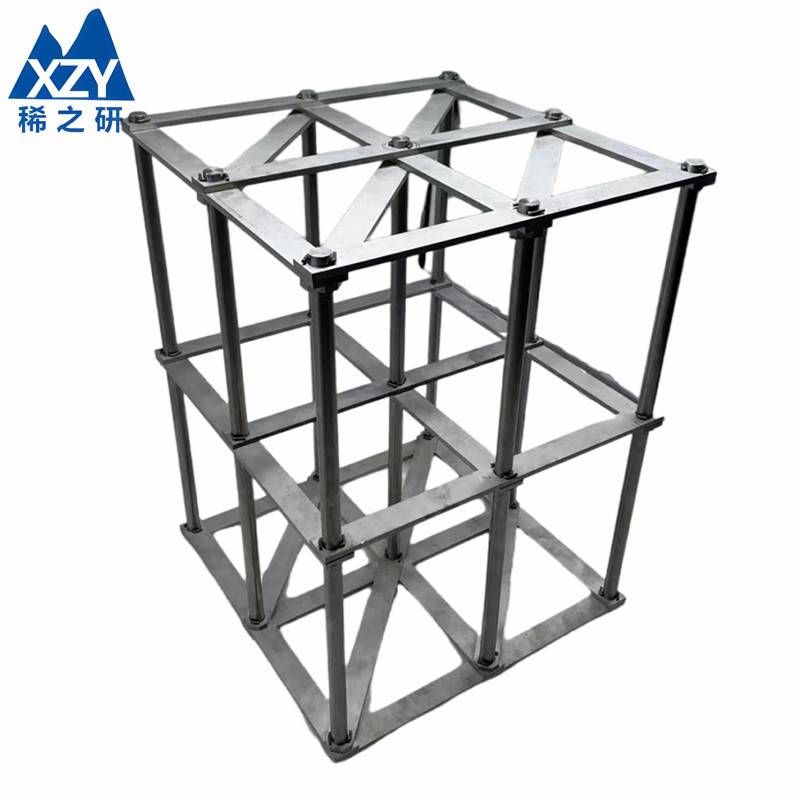
5. Molybdenum Racks
Molybdenum racks are used in semiconductor manufacturing and other industries for holding and transporting components. The electrical resistance of the racks can affect the performance of the components, especially in applications where electrostatic discharge (ESD) protection is required.
Contact Us for Molybdenum Wire Procurement
If you're interested in purchasing high-quality molybdenum wire for your specific application, we're here to help. As a leading supplier of molybdenum products, we offer a wide range of molybdenum wire with different dimensions, resistances, and purities to meet your requirements. Our experienced team can provide you with technical support and guidance to ensure you select the right product for your needs.
Whether you need molybdenum wire for heating elements, electrical contacts, wire cutting, or any other application, we can offer you competitive prices and reliable delivery. Contact us today to start a procurement discussion and explore the possibilities of using our molybdenum wire in your projects.
References
- "Handbook of Electrical Resistivity of Metals and Alloys" by C. A. Wert and R. M. Thomson
- "Introduction to Materials Science for Engineers" by James F. Shackelford
- "Molybdenum: Properties, Processing, and Applications" by G. E. Totten and M. A. Streicher
