

Hey there! As a supplier of pure tungsten tubes, I often get asked about how these tubes play a crucial role in generating X - rays in X - ray tubes. So, let's dive right in and break down this fascinating process.
First off, let's understand what X - rays are. X - rays are a form of electromagnetic radiation, just like light, but with much higher energy and shorter wavelengths. They're super useful in various fields, from medicine for diagnosing broken bones to industry for inspecting the integrity of materials.
Now, the star of our show is the pure tungsten tube. Tungsten is an amazing metal. It has an extremely high melting point (about 3422°C), which is crucial because the process of generating X - rays produces a ton of heat. If we used a metal with a lower melting point, it would simply melt away during operation.
In an X - ray tube, there are two main parts: the cathode and the anode. The cathode is where the electrons are produced, and the anode is where the X - rays are generated. And here's where our pure tungsten tube comes into play.
Let's start with the cathode. Inside the cathode, there's a small filament, often made of pure tungsten. When an electric current is passed through this filament, it gets heated up. This heating is called thermionic emission. As the filament gets hotter and hotter, it starts to release electrons. Think of it like a pot of water on a stove. When the water gets hot enough, it starts to turn into steam. In the same way, when the tungsten filament gets hot enough, electrons start to “boil off” from its surface.

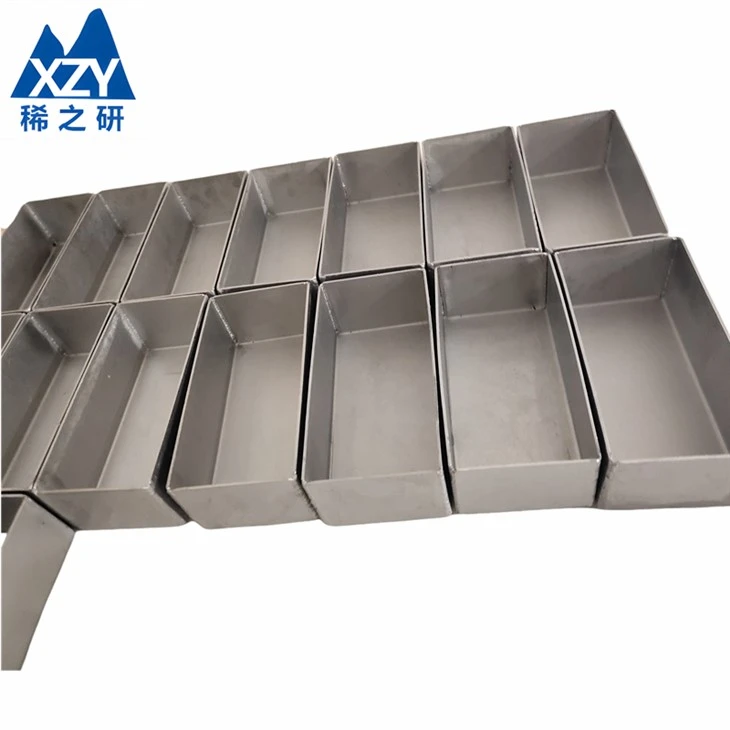
These electrons are then accelerated towards the anode. The anode is usually a large block of metal, and in most X - ray tubes, a pure tungsten tube is used as a key component of the anode. The electrons are accelerated by applying a high voltage between the cathode and the anode. This high voltage gives the electrons a huge amount of energy.
Once the high - energy electrons hit the tungsten tube (anode), two main processes occur that lead to the generation of X - rays: bremsstrahlung and characteristic X - ray emission.
Bremsstrahlung is a German word that means “braking radiation”. When the high - energy electrons enter the tungsten tube, they interact with the electric fields of the tungsten atoms. As they get close to the positively charged nuclei of the tungsten atoms, they get deflected and slowed down. This sudden change in the electrons' speed and direction causes them to lose energy. And this lost energy is emitted in the form of X - rays. It's like a car suddenly hitting the brakes. When the car slows down, the energy that was used to keep it moving is released in different forms, like heat and sound. In the case of electrons hitting the tungsten tube, the energy is released as X - rays.
Characteristic X - ray emission is a bit more specific. When the high - energy electrons hit the tungsten atoms in the tube, they can knock out inner - shell electrons from the tungsten atoms. When an inner - shell electron is knocked out, an electron from an outer shell fills the empty space. When this happens, the difference in energy between the outer and inner shells is released as an X - ray photon. Each element has a unique set of energy levels for its electrons, so the X - rays produced in this way have specific energies that are characteristic of tungsten.
The combination of bremsstrahlung and characteristic X - ray emission results in a spectrum of X - rays being produced. The X - rays then pass through a window in the X - ray tube and are directed towards the object that needs to be examined, whether it's a patient's body in a medical setting or a piece of machinery in an industrial application.
Now, I'd like to mention some other products related to pure tungsten that we also offer. If you're interested in thin - film deposition, we have Tungsten Sputtering Target. These targets are used to deposit thin layers of tungsten on various surfaces. They're made with high - purity tungsten, just like our tubes, ensuring high - quality deposition.
For applications that require high - temperature containers, we have Pure Tungsten Crucible. These crucibles can withstand extremely high temperatures without melting or reacting with other materials, making them ideal for processes like metal melting and chemical reactions at high temperatures.
And if you're in the field of vacuum evaporation, our Tungsten Evaporation Boat is a great choice. It's designed to hold materials that need to be evaporated in a vacuum environment. The high melting point and excellent thermal properties of tungsten make it perfect for this job.
So, as you can see, pure tungsten tubes are not only crucial for X - ray generation but also have a wide range of other applications. Whether you're in the medical industry, working on research projects, or involved in industrial manufacturing, our pure tungsten products can meet your needs.
If you're interested in purchasing pure tungsten tubes or any of our other tungsten products, don't hesitate to get in touch. We're always happy to have a chat about your specific requirements and how our products can fit into your projects. We have a team of experts who can answer all your questions and help you make the right choice.
In conclusion, the process of generating X - rays in X - ray tubes is a complex but fascinating one, and pure tungsten tubes are at the heart of it. Their unique properties, such as high melting point and excellent thermionic emission capabilities, make them the ideal choice for this critical application. And with our wide range of related tungsten products, we're your one - stop - shop for all things tungsten.
References
- Kaeff, H. (1997). Principles of Charged Particle Acceleration. Wiley - VCH.
- Bushberg, J. T., Seibert, J. A., Leidholdt, E. M., & Boone, J. M. (2012). The Essential Physics of Medical Imaging. Lippincott Williams & Wilkins.
